


Table of Contents
- How to Verify Online Jewelry Store Legitimacy
- Understanding the Custom Jewelry Design Process Steps
- Best Payment Methods for High-Value Online Purchases
- Verifying Gemstone Quality and Metal Purity
- Custom Jewelry Return and Refund Policies
- Shipping and Insurance for Custom Jewelry Orders
- How to Order Custom Jewelry Online Safely: Your Checklist
- Conclusion
Last Updated: August 5, 2026
How to Verify Online Jewelry Store Legitimacy
Ordering custom jewelry online means trusting someone with a significant purchase and deeply personal design. Before you commit, verify that the store actually exists as a legitimate business and has a track record of delivering quality work.

Check for business registration and certifications
Start by confirming the business is registered and operates legally. Search the company name on the Better Business Bureau website to see if they're accredited and their rating. Check your state's Secretary of State database for business registration records. A legitimate custom jewelry retailer will have a registered business entity, an EIN, and verifiable contact information.
Look for industry certifications that signal expertise. The American Gem Society (AGS) certifies gemologists and jewelers who meet rigorous standards. The Gemological Institute of America (GIA) provides diamond grading certifications that reputable jewelers display. Ask for documentation of certifications before placing an order.
Legitimate custom jewelers operate from a physical storefront or registered workshop. If the website lists only a P.O. box or no address, that's a red flag. Visit the address on Google Maps to confirm it's real. Many custom jewelers operate primarily online but maintain a registered business address and offer video consultations or in-person appointments by request.
Review customer testimonials and ratings
Read reviews on multiple platforms: Google Reviews, Trustpilot, and the Better Business Bureau. Look for specific details, customers mentioning actual pieces, timelines met, and communication quality. Generic praise is less reliable than detailed accounts of the design process.
Pay attention to how the jeweler responds to negative reviews. A business that addresses complaints professionally demonstrates customer care. Ignore criticism or defensive responses signal potential problems.
Watch for review patterns over time. A jeweler with consistent 4-5 star ratings across dozens of reviews over multiple years is more trustworthy than one with only recent reviews or a sudden cluster of new testimonials.
Red flags to avoid when ordering online
Avoid any jeweler who pressures you to pay the full amount upfront before design approval. Legitimate custom jewelers use staged payments: a deposit to start design work, payment after you approve the CAD rendering, and final payment before shipping.
Be suspicious of jewelers who won't provide written design specifications or CAD renderings. Custom work should be documented in writing and visually confirmed before production begins.
Check the website for security indicators. Look for "https://" in the URL (not just "http://"), a padlock icon in your browser's address bar, and a privacy policy explaining how they handle payment information. Outdated sites with broken links or generic stock photos instead of actual work photos are warning signs.
Avoid jewelers with no clear return or dispute resolution policy. Custom pieces are non-returnable by nature, but the jeweler should have a process for handling quality issues, sizing problems, or pieces that don't match the approved design.
Understanding the Custom Jewelry Design Process Steps
The custom jewelry design process varies between jewelers, but the core workflow is similar. Understanding what to expect helps you communicate clearly and catch problems before they become expensive mistakes.
Initial consultation and design specifications
Your first conversation should cover your vision in detail. Discuss the piece's purpose, your preferred metal (gold, silver, platinum), and any gemstones you want included. Provide reference images, photos of jewelry you like help the jeweler understand your aesthetic.
The jeweler should ask clarifying questions about your lifestyle, budget, and timeline. A professional will explain trade-offs upfront rather than promising the impossible.
Request written confirmation of your specifications: metal type and purity, gemstone specifications, dimensions, and any custom details like engraving. Having this in writing prevents misunderstandings later.
CAD rendering and digital proofing
After the initial consultation, the jeweler creates a CAD rendering, a detailed digital 3D model of your piece. Review the proportions, stone placement, and custom details. Does the band width look right? Is the stone secure in its setting?
Most jewelers allow revisions at this stage. If something doesn't match your vision, ask for changes and request a new rendering. This is the cheapest time to make adjustments; once production starts, changes become expensive or impossible. Approve the CAD rendering in writing before the jeweler proceeds.
Some jewelers also create a wax model, a physical prototype that shows the piece's three-dimensional form. Holding a wax model reveals details that a digital image might miss: how the piece feels and whether proportions work in reality.
Production timeline and communication
Ask the jeweler for a realistic production timeline before you start. Custom pieces typically take 4-8 weeks depending on complexity and current workload. Understand what timeline you're paying for and when to expect updates.
Establish a communication schedule. How often will the jeweler check in? Will they send progress photos? Clear communication expectations prevent surprises and give you confidence that your piece is being made correctly.
Once production begins, the jeweler should provide updates at key milestones: when materials are sourced, when fabrication begins, when the piece is complete and inspected, and when it ships. Radio silence is a warning sign.
Best Payment Methods for High-Value Online Purchases
Paying for custom jewelry online requires security measures that protect both you and the jeweler. Choose payment methods that offer buyer protection and verification.
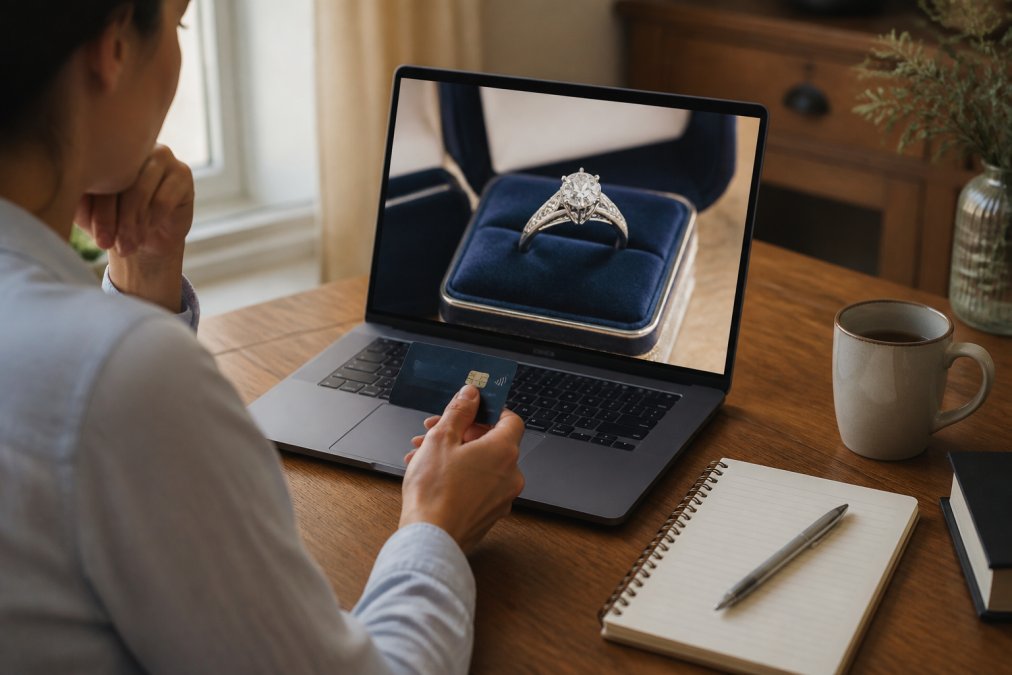
Secure payment gateways and encryption
Use a credit card or payment platform with fraud protection. Credit cards offer chargeback rights if the jeweler fails to deliver or the piece doesn't match the agreed design. Debit cards and wire transfers offer less protection.
Verify that the jeweler's website uses a secure payment gateway. Look for "https://" in the checkout URL and a padlock icon in your browser. Reputable payment processors like Stripe, Square, and PayPal add another layer of security by handling payment processing without exposing your card details to the jeweler.
Never send payment via wire transfer, cryptocurrency, or money transfer apps like Venmo or CashApp for custom jewelry. These methods are irreversible and offer no buyer protection.
Escrow services and staged payments
For high-value pieces, request staged payments:
- 50% deposit when you approve the design
- 25% when production is complete and inspected
- 25% upon shipping
This protects you by ensuring the jeweler doesn't have all your money before proving they can deliver.
Some online jewelers use escrow services, where a third party holds your payment until you confirm receipt of the finished piece. The jeweler knows they'll be paid once you receive and approve the piece. You know your money won't be released until the piece arrives and meets your expectations.
Ask if the jeweler offers escrow. If not, negotiate a staged payment plan. Any reputable custom jeweler should be comfortable with this arrangement.
Verifying Gemstone Quality and Metal Purity
Custom jewelry is only as valuable as the materials used. Verify that gemstones and metals meet the specifications you agreed to before production.
Gemstone certification and conflict-free diamonds
If your piece includes a diamond or colored gemstone, request a certification from an independent lab. The GIA, AGS, or International Gemological Institute (IGI) provide third-party grading that confirms the stone's carat weight, color, clarity, and cut. Certification protects you by providing objective verification.
For diamonds, ask about conflict-free sourcing. Conflict-free diamonds are mined and traded under conditions that don't fund armed conflict. A reputable jeweler can provide documentation of where their diamonds come from.
If you're using a gemstone you already own, ask the jeweler to have it appraised by an independent gemologist before setting. This creates a record of the stone's condition and value before work begins.
Hallmarking and karat weight verification
Precious metals must be marked with a hallmark indicating metal type and purity. Gold is marked by karat (10K, 14K, 18K). Silver is marked by fineness (925 for sterling silver). Platinum is marked by fineness (950 or 900). These hallmarks are legal requirements and assure you that the metal is what the jeweler claims.
Request that your finished piece be hallmarked by the jeweler or sent to an independent assay office for verification. Ask for documentation of metal weight and purity. This matters for insurance purposes and understanding the piece's intrinsic value.
Custom Jewelry Return and Refund Policies
Custom pieces are typically non-returnable because they're made specifically for you. However, the jeweler should have a clear policy for handling quality issues and disputes.
Understanding warranty coverage and resizing
Understand what's covered under warranty. Most jewelers warranty their work against manufacturing defects, broken prongs, loose stones, or craftsmanship problems for one year. What's typically not covered: damage from wear and tear, loss of stones due to impact, or damage from improper care.
Resizing is often a separate service with its own cost. Ask whether resizing is included in the warranty period or charged separately. Clarify the policy upfront.
Some jewelers offer lifetime maintenance, cleaning, polishing, and minor repairs at no charge. If the jeweler offers this, get it in writing.
Dispute resolution and legal rights for custom commissions
If you receive a piece that doesn't match the approved design, document the discrepancy with photos and contact the jeweler immediately. A professional will work to correct the problem, either by modifying the piece or offering a refund or remake.
Custom commissions are protected under contract law. If the jeweler fails to deliver a piece matching the agreed specifications, you have grounds for a dispute. Keep all written communications, design approvals, and CAD renderings as proof of what was promised.
If the jeweler refuses to address a legitimate quality issue, you can dispute the charge with your credit card company or pursue a small claims lawsuit. Document everything: photos of the piece, emails with the jeweler, approved design specifications, and written descriptions of discrepancies.
Shipping and Insurance for Custom Jewelry Orders
Shipping high-value custom jewelry requires care and insurance. Confirm shipping details and insurance coverage before the piece leaves the jeweler's hands.
Ask how the jeweler ships custom pieces. Reputable jewelers use insured, signature-required shipping through USPS, UPS, or FedEx. This ensures the package is tracked and requires your signature upon delivery.
Confirm the insurance value. The jeweler should insure the piece for its full value. Ask whether insurance is included in the final price or charged separately. Understand what happens if the package is lost or damaged in transit.
Request tracking information and insurance documentation. You should receive a tracking number to monitor the shipment. Keep this documentation until the piece arrives and you've inspected it.
When the piece arrives, open it carefully and inspect it immediately. Check for any damage during shipping, verify that the contents match the agreed design, and confirm that gemstones are secure. If there's any damage or discrepancy, document it with photos and contact the jeweler or shipping carrier within 48 hours.
How to Order Custom Jewelry Online Safely: Your Checklist
Use this checklist to ensure you've covered all the security and verification steps before placing an order:
- Verify the jeweler's business registration and check their Better Business Bureau rating
- Read detailed customer reviews on multiple platforms (Google, Trustpilot, BBB)
- Confirm the jeweler has a physical business address and legitimate contact information
- Request written design specifications covering metal type, gemstone details, and dimensions
- Review the CAD rendering and approve it in writing before production begins
- Establish a communication schedule and timeline for the custom piece
- Use a credit card or secure payment gateway (never wire transfer or cryptocurrency)
- Negotiate staged payments: 50% deposit, 25% at completion, 25% at shipping
- Request gemstone certification from an independent lab (GIA, AGS, or IGI)
- Confirm metal hallmarking and request documentation of purity and weight
- Review the warranty policy and understand what's covered
- Verify shipping will be insured and signature-required
- Keep all written communications, design approvals, and CAD renderings
- Inspect the piece immediately upon arrival and document any issues with photos
- Confirm you understand the return/refund policy and dispute resolution process
Conclusion
Ordering custom jewelry online safely requires diligence, but it's absolutely achievable when you verify legitimacy, understand the design process, and use secure payment methods. At Treasure Charms, we understand that custom pieces celebrate your most meaningful relationships, which is why we prioritize clear communication, transparent design approval, and USA-assembled craftsmanship. Before placing your order anywhere, confirm business registration, review detailed customer feedback, use staged payments, request CAD renderings, and verify gemstone certifications. These steps protect your investment and ensure the piece you receive matches the vision you approved. Get started with Treasure Charms' custom jewelry design process and experience how thoughtful personalization creates lasting memories.
Frequently Asked Questions
How can I verify if an online custom jeweler is legitimate before placing an order?
Check for business registration with your state's Secretary of State office, look for physical address and phone number on their website, and verify customer reviews on independent platforms. Legitimate jewelers display gemstone certifications, hallmarking information, and clear warranty details. Ask for references from past clients and confirm they use secure payment methods. Reputable custom jewelry designers will provide detailed design contracts and communicate openly about timelines and materials.
What payment methods offer the best protection when ordering custom jewelry online?
Credit cards provide strong fraud protection through your card issuer's dispute process. PayPal and similar services offer buyer protection for custom orders. For high-value pieces, escrow services hold payment until you approve the final product, protecting both you and the jeweler. Avoid wire transfers and cryptocurrency, which offer no recourse if something goes wrong. Always use secure payment gateways with SSL encryption (look for the padlock icon in your browser).
How do I ensure accuracy with my custom design before the jeweler starts production?
Request a CAD rendering or digital proof showing your exact specifications, including gemstone placement, metal type, karat weight, and any custom engraving. Review dimensions carefully and verify that gemstone certifications match your agreement. Communicate any changes in writing before the jeweler begins fabrication. Most reputable designers provide multiple rounds of digital proofing at no extra charge. Confirm the production timeline in your design contract so you know when to expect updates.
What should I look for in a custom jewelry return or refund policy?
A solid policy should cover defects in craftsmanship and materials for at least one year. Check whether resizing and repairs are included or have separate fees. Understand the timeline for returns (typically 30-60 days) and whether the jeweler covers return shipping. Verify what happens if the final piece doesn't match the approved design. Reputable jewelers offer warranty coverage on precious metals and gemstone settings. Always get the return policy in writing before you order.
This article was written using GrandRanker


