


Table of Contents
- Set Your Budget and Understand What You're Paying For
- Research Designers and Jewelers You Can Trust
- Understand the Custom Jewelry Design Process
- Master the 4Cs and Metal Selection for Your Custom Piece
- Key Questions to Ask Your Custom Jeweler
- Choose Your Setting Style and Customization Options
- Verify Warranties, Insurance, and Long-Term Care
- Tips for Buying Custom Jewelry: Final Checklist
Tips for Buying Custom Jewelry: A Step-by-Step Guide
Last Updated: August 4, 2026
When you're ready to invest in a piece that's truly one-of-a-kind, understanding the fundamentals of tips for buying custom jewelry becomes essential. Unlike mass-produced pieces, custom jewelry requires understanding your budget, knowing what questions to ask, and recognizing the value you're paying for. Below, we'll walk you through each stage of buying custom jewelry, from initial budget planning through long-term maintenance, so you can make decisions with confidence.
Set Your Budget and Understand What You're Paying For
Custom jewelry costs more than retail pieces because you're paying for design expertise, personalized consultation, skilled craftsmanship, and the ability to specify exactly what you want. The design process itself represents a meaningful portion of the final cost.
Custom jewelry pricing includes materials (precious metals and gemstones), labor (design, mockups, and construction), and overhead (studio, tools, insurance). Retail pieces are mass-produced with limited personalization, so retailers buy in bulk at lower per-unit costs. With custom work, you eliminate middlemen and gain precision and exclusivity.
Research Designers and Jewelers You Can Trust
Finding the right jeweler is more important than finding the right design. Start by asking for referrals from friends, family, or local jewelry stores. Personal recommendations carry weight because they come from people who've seen the finished product.
Verify credentials by asking how long the jeweler has been in business, requesting examples of custom pieces, and asking for client references. Examine their portfolio carefully, assessing both technical skill and design aesthetic. Red flags include pressure to decide quickly, refusal to provide written quotes or timelines, dismissiveness of your ideas, or inability to explain their design process clearly. Trust your instincts.
Research designers online by checking reviews, examining social media galleries, and reading testimonials. Better Business Bureau reviews for jewelry artisans can provide insight into how businesses handle complaints. Look for patterns in feedback about communication, quality, and timeline accuracy.
Understand the Custom Jewelry Design Process
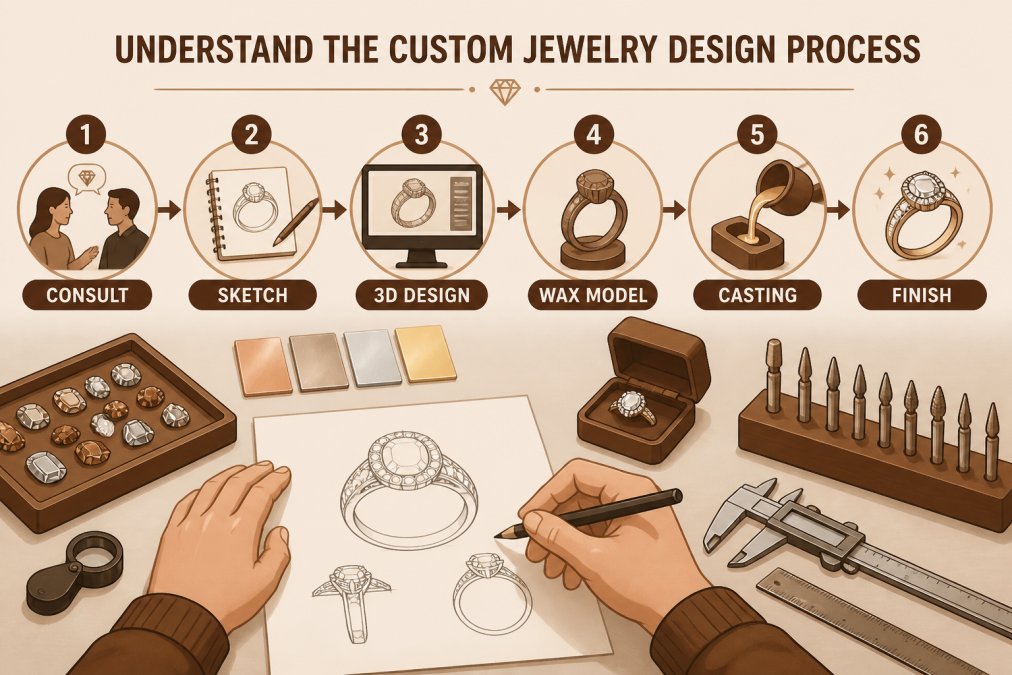
The custom design process typically unfolds in distinct phases. Initial consultation is where you discuss your vision, budget, and timeline. The jeweler asks questions about your lifestyle and preferences to establish whether you're a good fit for working together.
The design sketch is a hand-drawn or digital illustration showing the basic concept. This is a conversation starter for refinement. CAD (computer-aided design) creates a precise 3D model, and digital rendering shows exactly what the finished jewelry will look like from every angle. Some jewelers create physical wax models before final metalwork, allowing you to hold the piece and make adjustments before casting.
Timeline expectations vary widely. A simple custom piece might take 4-8 weeks from consultation to delivery. More complex designs can take 8-12 weeks or longer. Rush options exist but typically cost more and may compromise quality.
Master the 4Cs and Metal Selection for Your Custom Piece
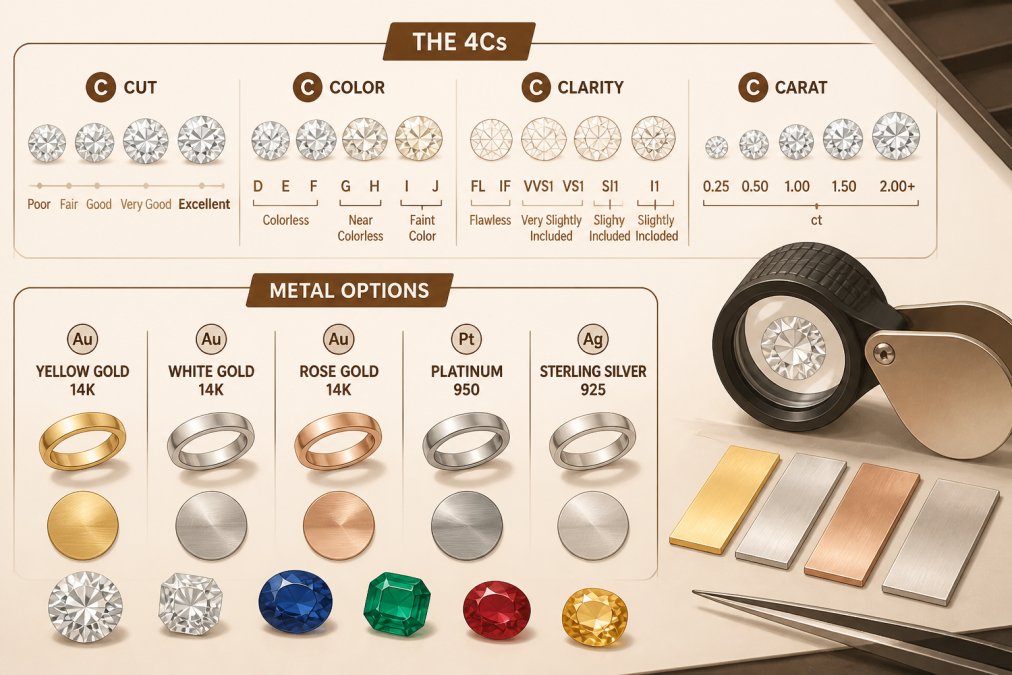
Understanding the 4Cs framework gives you control over both quality and cost. Carat weight measures the stone's size; larger stones cost exponentially more because they're rarer. Clarity describes the absence of inclusions; VS1 and VS2 grades offer excellent clarity at lower cost than flawless. Color grades range from D (colorless) to Z (light color); near-colorless grades (G-J) offer excellent appearance at lower cost. Cut quality determines how well the stone reflects light; a well-cut diamond of lower color or clarity can outshine a poorly cut diamond of higher grades.
Precious metals form the foundation of your piece. Gold comes in different karats: 18K (75% gold) offers durability with rich color; 14K (58.3% gold) is more affordable and extremely durable; 10K (41.7% gold) is the minimum for US jewelry. Platinum is denser, more durable, and hypoallergenic but costs significantly more. Silver is affordable but softer and requires more maintenance.
Lab-grown diamonds are chemically identical to mined diamonds but cost 30-40% less and avoid ethical concerns. Natural diamonds carry the prestige of rarity. Conflict-free certification ensures diamonds weren't mined in war zones or under exploitative conditions.
Key Questions to Ask Your Custom Jeweler
Ask about design and timeline specifics: How many design revisions are included? What happens if you request changes after CAD design? How long will the project take? Can the jeweler accommodate rush timelines and at what cost?
Ask quality and materials questions: Will the jeweler provide gemstone certification from the Gemological Institute of America (GIA)? What's the warranty on craftsmanship and what does it cover? How will they source the diamond or gemstone, and what's the markup? Can you see the stone in person before final commitment?
Ask about deposit, warranty, and policies: What deposit is required and what's the refund policy? What percentage is due at different project stages? What's the warranty period and what does it cover? What happens if the finished piece doesn't meet your expectations?
Choose Your Setting Style and Customization Options
Setting style dramatically affects both appearance and durability. Prong settings use metal claws to hold the stone, maximizing light exposure but vulnerable to snagging. Bezel settings surround the stone's edge with metal, offering maximum protection and a modern look. Pavé settings feature small diamonds set closely together, creating a glittering effect but requiring careful maintenance.
Other popular settings include three-stone designs, halo settings, and tension settings. Each has aesthetic and practical implications. Consider your lifestyle when choosing a setting. If you work with your hands or exercise frequently, a bezel or tension setting offers more protection than delicate prongs.
Verify Warranties, Insurance, and Long-Term Care
Warranty coverage protects against manufacturing defects but typically doesn't cover damage from accidents or negligence. A reputable jeweler offers a warranty covering loose stones, broken prongs, or faulty metalwork for one to two years. Read the fine print carefully about resizing and normal wear coverage.
After your custom piece is complete, have it appraised by an independent gemologist. This appraisal documents the stone's characteristics and value, essential for insurance purposes. Most homeowner's or renter's insurance policies have limited jewelry coverage; a separate jewelry insurance policy ensures full replacement value.
Post-purchase maintenance keeps your piece beautiful for decades. Have your jeweler clean and inspect it every 6-12 months, especially if it features prongs or pavé settings. Remove jewelry before swimming, exercising, or using harsh chemicals. Store it in a soft pouch away from direct sunlight. For gold and platinum, occasional gentle cleaning with warm soapy water and a soft brush maintains shine.
Tips for Buying Custom Jewelry: Final Checklist
Start with a realistic budget accounting for materials, design, labor, and potential revisions. Research jewelers thoroughly, prioritizing reputation and portfolio quality over price. Understand the design process timeline and phases involved. Master the basics of gemstone quality and metal selection. Ask detailed questions about design revisions, materials sourcing, warranties, and policies before signing any agreement. Choose a setting style that balances aesthetics with durability based on how you'll wear the piece.
Plan for long-term care through professional appraisal, appropriate insurance, and regular maintenance. A custom piece represents both financial and emotional investment; treating it with proper care ensures it remains beautiful for generations.
Creating a custom jewelry piece should feel exciting, not overwhelming. The process rewards careful planning and clear communication with your jeweler. Treasure Charms specializes in personalized gifts that celebrate meaningful relationships, and whether you're commissioning a custom piece through us or working with an independent jeweler, these fundamentals apply universally. Start by clarifying your vision, choosing a jeweler you trust, and committing to the timeline required for quality craftsmanship. The result is a piece that tells your story in a way no retail jewelry ever could.
Gemological Institute of America diamond grading standards
Federal Trade Commission guidelines on jewelry labeling and disclosure
American Gem Society standards for ethical gemstone sourcing
Frequently Asked Questions
What questions should I ask a custom jeweler before placing an order?
Ask about the design timeline, deposit requirements, revision policy, and how they handle corrections. Request details on gemstone sourcing, metal purity and hallmark standards, warranty coverage, and whether they provide CAD designs or physical wax models. Inquire about their process for verifying your customization details before production to prevent errors. Also ask about appraisal services and post-purchase maintenance support.
How long does the custom jewelry design process typically take?
A standard custom jewelry design process takes 4-8 weeks from initial consultation to final delivery. The timeline includes the initial design sketch phase (1-2 weeks), CAD design and revisions (1-3 weeks), and production and finishing (2-4 weeks). Rush options exist but may incur additional fees. Discuss your deadline during the consultation so the jeweler can confirm feasibility and provide accurate timeline expectations.
What's the difference between cost of custom jewelry versus retail pieces?
Custom jewelry typically costs more than mass-produced retail pieces because you're paying for design consultation, personalized labor, materials sourcing, and artisan craftsmanship. Retail jewelry spreads manufacturing costs across thousands of identical pieces. Custom work involves individual attention to your specifications, multiple design revisions, and often higher-quality precious metals and gemstones. The USA-assembled advantage also reflects fair labor practices and quality control standards that mass production cannot match.
How do I ensure my custom jewelry order is correct before it ships?
Request a detailed CAD design or physical wax model review before production begins. Review all customization details in writing, including names, dates, gemstone specifications, and metal type. Many reputable jewelers provide digital renderings or photos of the wax model for approval. Ask about their verification process and whether they offer a final inspection step. Confirm the jeweler will contact you if any details seem unclear before proceeding to production.
This article was written using GrandRanker


